
What people *think* I teach as a dance educator …
Ok dance teachers, raise your hand if this sounds familiar:
You are meet someone new. Maybe you are at your first visit to a new hair salon or making small talk while you wait in line at the grocery store. The conversation turns to occupations, and you tell them that you are a dance teacher. I’ve discovered that there are 3 reactions that are most likely to occur:
1.) “Oh, I’m a terrible dancer! Maybe you can give me lessons! My friend’s wedding is next week, think you can teach me a few moves to do on the dance floor?”
2.) “Oh, I was a dancer! I took ballet when I was 5! The costumes were so pretty.”
3.) “Oh, do you teach, like flips and stuff? Do you stand on your toes? Are all the dancers really skinny? What do you really do to make money? Is everyone really mean? Do you win a lot of competitions? Can you do the splits?
OK … maybe I’ve gotten a few more “typical” responses – “What styles do you teach?” “How old are your students?” “Aren’t you lucky to make a living doing what you love?” People aren’t always weird about it, even if it feels that way! But I do hear responses like those above more than one might guess, and it starts to get to me after a while. I know that people can’t necessarily help how they perceive dance. They only know of it what they have been exposed to through movies, TV, or maybe a handful of firsthand experiences like going to their cousin’s dance recital as a kid. And to be honest, those are not always the best representations of our art form – think Black Swan and Dance Moms, for example.
So I understand that people may not really understand what dance education really is – and I even understand if they find it a little frivolous or silly. But just for fun, I’ve put together a little list of some of the things people *think* I teach as a dance educator:
- Fancy spins
- How not to get dizzy when you are doing all those fancy spins
- Cool jumps
- Flips and Tricks
- The Splits
- Holding your leg up by your ears
- Standing on your toes
- Rolling on the floor
- Making “weird” shapes and doing “weird” stuff (i.e.: Contemporary Dance)
- Flitting around pretending to be a butterfly (and THAT one came from a fellow dance educator!)
What are some silly or strange things that people thought that YOU teach as a dance educator? Share in the comments!
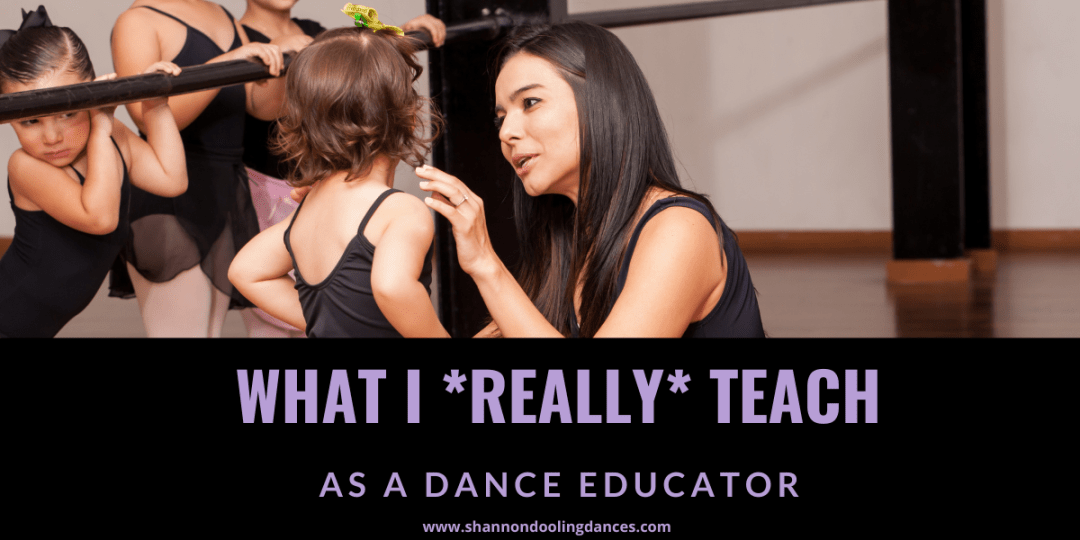
What I *really* teach as a dance educator …
Sometimes in the midst of these conversations, I just want to stand on the table and yell … DANCE IS A REAL THING! IT’S A PRIMAL PART OF HUMAN CULTURE. WE STARTED DANCING BEFORE WE DEVELOPED LANGUAGE. WE ARE MADE TO MOVE, TO EXPRESS, TO DANCE. BEING A DANCE TEACHER IS A REAL JOB! MY STUDENTS ARE REACHING THEIR FULL HUMAN POTENTIAL THROUGH THEIR DANCE TRAINING – AND THEY ARE LEARNING SO MUCH MORE THAN HOW TO “STAND ON THEIR TOES!”
Of course, I can’t do that – but what I can do is use this blog as a means to communicate the value of dance and dance education. I can share with my readers what I learned through dance, how transformative it has been for me, and the positive impact I try to have for my dance students through their dance training.
Because, while it might look like students are just “flitting around like a butterfly” in creative movement, what they are really doing is practicing cross-lateral and upper-lower body coordination, spatial awareness, balance, and proprioception – while using playfulness and creativity to engage their imaginations and help them enjoy the experience.
While it might look like students are just “being weird” in contemporary dance choreography, what they are really learning is to communicate non-verbally, express their emotions, use observation and analysis skills, and be open to new perspectives, ways of doing things, and being in the world.
While it might look like students are just “standing on their toes” in pointe classes, what they are really experiencing is the reward of years of hard work, persistence, self-discipline, motivation, and practice. They are reaping the benefits of their dedication to the art of ballet, commitment to their training, and self-motivation to meet their goals.
As a dance educator, these skills are far more important to me than how many fouetté turns my students can do, how high their extension gets, or whether or not they go on to a professional career. Of course, I do my best to support them in all of those endeavors, too. I try to help them to become the best dancer and best artist they can be, regardless of what society thinks. As dancers, we know that the arts have intrinsic value. Learning to dance or play an instrument or paint or sculpt or write poetry brings joy and creative freedom and meaningful expression to the participant – and that is enough. We know that the arts and arts education don’t have to have purposes beyond or outside of themselves.
But society is, by and large, moved more by the “other” benefits of the dance and the arts, beyond the joy, freedom, and meaning they offer in and of themselves. Stakeholders, in general, are moved by practicalities: how will my child earn a living if they graduate with “just” a dance degree, how will adding dance to the curriculum help improve test scores, how much revenue does this performing arts organization generate? They don’t necessarily care about butterfly runs, innovative choreographic practices, or dancing en pointe. They want to know what practical skills dance, and the other arts, can offer to participants.
You might look at a dancer and just see pretty lines, unusual shapes, or explosive tricks, but when I look at them, I see the resilience, creativity, and passion it took to learn them. You might see me laughing with my students about a really weird metaphor I used to teach them the sharpness of a Graham contraction, and you might think we are wasting time or goofing off. But I know that we are really forming connections, developing trust, and accepting one another’s vulnerability. You might see a dancer on stage and think they are just showing off, but I see the courage it took to get out there, the confidence they are developing, and how their futures will be impacted by this experience. There is so much more to dance education than meets the eye, if you are willing to look beyond the surface.
Skills students learn through dance …
And so, for these stakeholders, and everyone I’ve had conversations with at the hair salon or in line at the grocery store who just didn’t understand what it is I do, I offer the following list of skills that I am *really* teaching as a dance educator. This list is in no way comprehensive, and I invite dance teachers, dancers, former dancers, choreographers, and dance parents to add your own in the comments!
- Responsibility
- Teamwork
- Confidence
- Accountability
- Creativity
- Trust
- Persistence
- Adaptability
- Leadership
- Self-Respect
- Respect for Others
- Collaboration
- Reaching your Potential
- Holding Multiple Perspectives
- Vulnerability
- Resilience
- Acceptance of Others
- Communication
- Self-Expression
- Self-Motivation
- Improvisation
- Attention to Detail
- Patience
- Self-Evaluation
- Curiosity
- Self-Awareness
- Hard Work
- Impulse Control
More on the social and emotional benefits of dance education
To learn more about the social and emotional benefits of dance education, I invite you to read these blog posts:
- 5 Vital Social and Emotional Skills Students Learn through Dance – and How to Teach Them
- 8 Invaluable Life Skills Learned through Dance
- How to Teach Social Skills in Dance Classes
- How to Teach Empathy in Your Dance Classes
Visit my Resources page for tools that support a holistic teaching practice and help dance students make the most of their training. Keep in touch by signing up for my quarterly newsletter, or join me on Facebook at The Holistic Dance Teacher.

I really enjoyed the above article, thank you for writing it.
Thank you for taking the time to read and let me know what you think! I appreciate it 🙂