
The Holistic Dance Teacher Guest Blog Series
Welcome to the second post in The Holistic Dance Teacher Guest Blog Series! Through this blog series, I will introduce you to some of the amazing dance industry professionals that I have had the opportunity to work with and be inspired by. The artists and educators in this series all align with The Holistic Dance Teacher Approach, and I think you’ll find their contributions interesting and helpful for your own teaching and creative practices.
Our guest blog post author is Rachel Leigh Caldwell, an Author, Speaker, Dance Educator, and Host of the Creative Impact Podcast. I had the opportunity to connect with Rachel during an online workshop on which we both served as panelists, and later was fortunate to be a guest on her podcast. (You can catch my episode here.) This post is FULL of helpful information that should allow you to develop healthier relationships and better balance in your career.
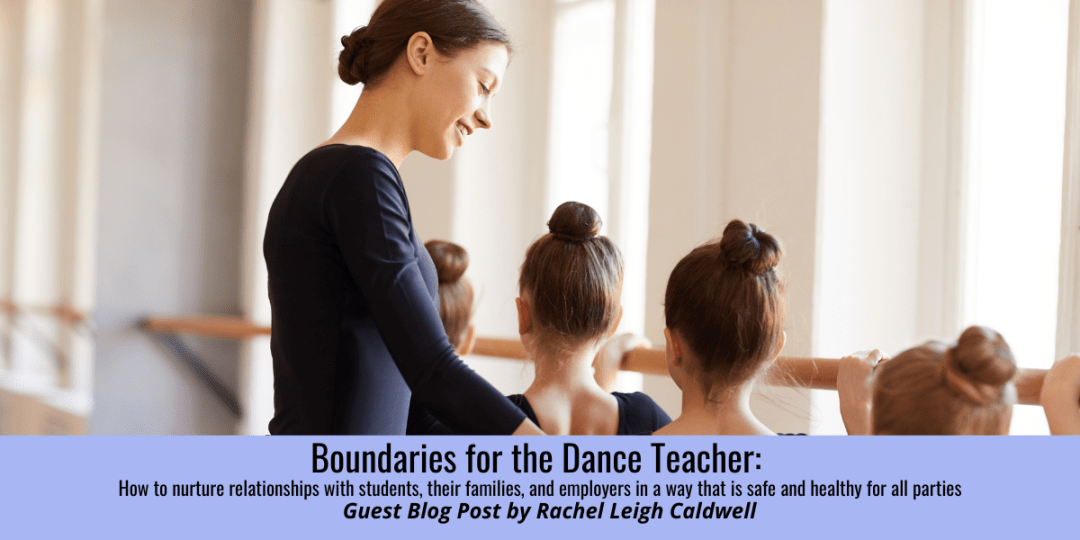
Boundaries for the Dance Teacher
Do you ever find yourself relaxed at the end of the day only to glance at your email and feel a wave of anxiety wash over you? Are you constantly feeling overwhelmed and stretched too thin? Does it seem like you can’t win—you feel like you’re dropping the ball at home or at work or both?
Dance Teachers have an incredible aptitude for giving and adding value to others. I am continually in awe of the passion and heart that my colleagues display as they lead and guide their students. While this giving posture is beautiful, it is also vital that you develop healthy boundaries so you don’t find yourself in a place of burnout or total depletion.
Or, maybe you find yourself numb and not able to muster up compassion and empathy for others. Sometimes the pendulum swings in the opposite direction and we turn inward, closing ourself off almost completely. We’ve been burned, so we create such rigid boundaries (more like solid brick walls than fences) in an effort to protect ourselves, but we’re left feeling unfulfilled and disconnected.
As you are well aware, there are a variety of relationships to consider as a teacher. Not only are you connecting with your students, you’re also interacting with their families, and working with colleagues or potentially employees if you’re a studio owner.
A huge part of our wellness is the health of our relationships. Our relationships affect our emotional, mental, and physical health—it’s truly all connected! No matter the state of your relationships today, the beautiful thing is that relationships are dynamic and constantly changing. You can experience positive change in your relationships by finding rhythms that support healthy boundaries.
How to nurture relationships with students, their families, and employers in a way that is safe and healthy for all parties
How can you nurture relationships with students, families, and employees? And, how can you do this in a way that is healthy and allows all parties to thrive? Let’s look together at five key areas:
Practice Self-Awareness
One of the best ways to start is by looking inward. Each of us have tendencies towards certain auto-responses or reactions as well as different strengths and weaknesses. It can be so helpful to take time to gain more self-awareness and practice noticing our own reactions in relationships. Building a healthy culture starts with moving towards health on a personal level. In my own co-worker relationships, I realized that I have a tendency to try to avoid conflict—to a fault. There were times when I allowed the goal of avoiding conflict to keep me from addressing relational issues or unrealistic expectations early on. “Ignore it and it will go away” was my unarticulated philosophy. The problem is, the issue wouldn’t go away. It would only grow. I came to realize that my own desire to “keep the peace” was not a path towards ultimate organizational or relational health. Is there a pattern you’ve developed in relating to others that is no longer serving you?
Another valuable aspect of self-awareness is to determine what you value most. What is important to you?
Communicate Expectations Clearly
A huge part of developing healthy boundaries and being able to maintain them involves clear communication. One of my favorite quotes is George Bernard Shaw’s reminder that “the single biggest problem in communication is the illusion that it has taken place.” Isn’t that the truth?! Often, we feel like we have communicated clearly, only to discover the message wasn’t received the way we intended. Have parents been messaging you late in the evening, upset if you don’t reply right away? Maybe you could take time to communicate what parents can expect as far as timelines for responses. You are only available between the hours of __ and __. The best way to communicate with you outside of those hours is __, and you will reply within __ hours/business days. Be clear with expectations, because as Brené Brown says, “clear is kind.” Whether that’s in personal relationships or with our co-workers, being transparent is so crucial! Just remember—you have to follow-through and stay consistent with the boundaries you establish (like not checking email after a certain time!). Is there an area that is causing you stress? How could you communicate an expectation to your students/families/employees to help to avoid similar issues moving forward?
Build a Foundation of Trust
Intentionally building a culture of trust is vital. In my book, Healthy Relationships = Healthy Team, the topic of trust is intentionally part of chapter one titled “A Solid Foundation”. If there isn’t trust in your organization, it is going to be difficult to move forward. It would be like trying to build a house without a foundation. Things may seem like they are working for a while, but eventually, the organization is going to break down. Trust is like the invisible glue that holds organizations together. I love Brene Brown’s “Anatomy of Trust” framework where she breaks down elements that contribute to trust in a relationship: Boundaries, Reliability, Accountability, Vault, Integrity, Nonjudgment, and Generosity. This framework is one of my favorite things to teach my students since trust can feel a bit abstract. Check out the YouTube video under the same name to learn more!
Some questions to ask yourself and your students include: Do you keep your word? Do you take ownership for your mistakes and work to make amends when needed? Are you living in line with your values? Do you assume the best of others?
Boundaries and trust go hand-in-hand. It’s a bit of a “did the chicken or egg come first?” situation. When you develop and maintain healthy boundaries, you increase trust. And, when you are in a trusting relationship, it is easier to set healthy boundaries.
Cultivate Empathy for Yourself and Others
Chapter seven of Healthy Relationships = Healthy Team is all about empathy—what I like to call “the secret ingredient”. Empathy comes down to truly seeing others and seeking to understand where they are coming from. Often it can feel uncomfortable at first, as we have to connect with a part of ourselves that has experienced the emotion that the other person is feeling. It is taking the perspective of the other with the end goal being connection. This keeps you from swinging too far on the boundaries pendulum to the point of isolation.
Empathy allows you to connect more deeply with others and strengthen relationships. But alongside that, don’t forget to cultivate empathy for yourself. Allowing yourself to feel your emotions and recognize them is important to maintaining healthy boundaries. Author Jennie Allen in her book Untangle Your Emotions breaks down approaching our emotions in a healthy way by noticing them, naming them, feeling them, sharing them, and then choosing what to do with them. Finding the middle point between ignoring our emotions and letting them control us. It’s easy to keep pushing and driving, all while ignoring the signals our body is giving us that there is something that needs attention or a boundary has been crossed.
It is key to differentiate yourself from the people around you. What is yours to feel or to fix, and what is theirs? The goal is to empathize with the other, while maintaining your individuality.
Handle Conflict in a Healthy Way and Teach Students to do the Same
Going through conflict can actually strengthen relationships and clarify boundaries, if it’s handled in a healthy way! In chapter four of Healthy Relationships = Healthy Team, I walk through conflict resolution “super powers”! A few of my favorite super powers are to go directly to the person and avoid gossiping about the situation with others, to start with generous assumptions, and to take responsibility for your part—no matter how small that may be!
Handling conflict is a learned skill. The dance classroom (and office, for that matter) is an excellent place to practice! One of the most effective ways to teach healthy conflict resolution is to model it or to help guide your students through it. I vividly remember sitting down with two of my students who were getting heated with each other and did not see eye to eye. We took some time to let each person share how they were feeling and their perspective on the situation. It was so eye-opening to watch their physicality and demeanor change from defensive and closed to empathetic and open in real time. As cheesy as it may seem, providing some prompts or questions can be an awesome way to get started. One great tip is to have each party start with “I feel” and generally use “I” statements instead of “you” statements.
Working through conflict with a goal of repairing the relationship is one major way to maintain and reestablish boundaries.
What’s Your Next Step?
The goal in setting and maintaining boundaries is mutual respect and valuing all parties’ well-being. It’s important to remember that though it takes work, at the end of the day, it is worth it to create an organization that is safe and provides a space for true connection and belonging.
So, what is your next step? Grab a cup of coffee and find a comfy chair, or maybe go for a walk and take a few minutes to reflect and notice which area you would like to intentionally grow in:
- Do you want to gain more self-awareness?
- Could you communicate your expectations more clearly?
- Do you have an established foundation of trust in your classroom or organization?
- Do you feel numb? Are you ready to focus on cultivating empathy for yourself and others?
- Is this a good time to intentionally work towards handling conflict in a healthy way and/or teaching your students to do the same?
Thank you for the work you do as a dance educator—pouring into the lives of students, their families, and your team each day! Know that your work has the potential to change lives for the better, and don’t forget to keep filling up your tank along the journey!
Want to dive deeper? Check out Rachel’s book Healthy Relationships = Healthy Team on Amazon!
About the Author

Rachel Caldwell is an Author, Speaker, Dance Educator, and Host of the Creative Impact Podcast. Rachel is a graduate of Belhaven University, where she received her BFA in Dance with a minor in Business Administration. Over the years, Rachel has enjoyed performing, teaching, and choreographing in a variety of settings. Rachel served as a high school Dance Director from 2017-2022. In 2022, Rachel founded Brighteyes Unlimited, LLC, to provide resources and workshop offerings designed to promote positive team culture. Her goal: helping teams thrive. Since founding her company, she has had the joy of working with teams and directors across her home state of Texas and beyond! Rachel’s heart is to encourage others and cultivate community, whether through workshops, speaking, or her podcast! You can learn more and connect with Rachel at https://rachelleighcaldwell.com/
Connect with Rachel!
- On Instagram or Facebook
- @rachel.leigh.caldwell
- @creativeimpactpodcast
- rachelleighcaldwell.com
- creativeimpactpodcast.com
- Healthy Relationships = Healthy Team on Amazon
