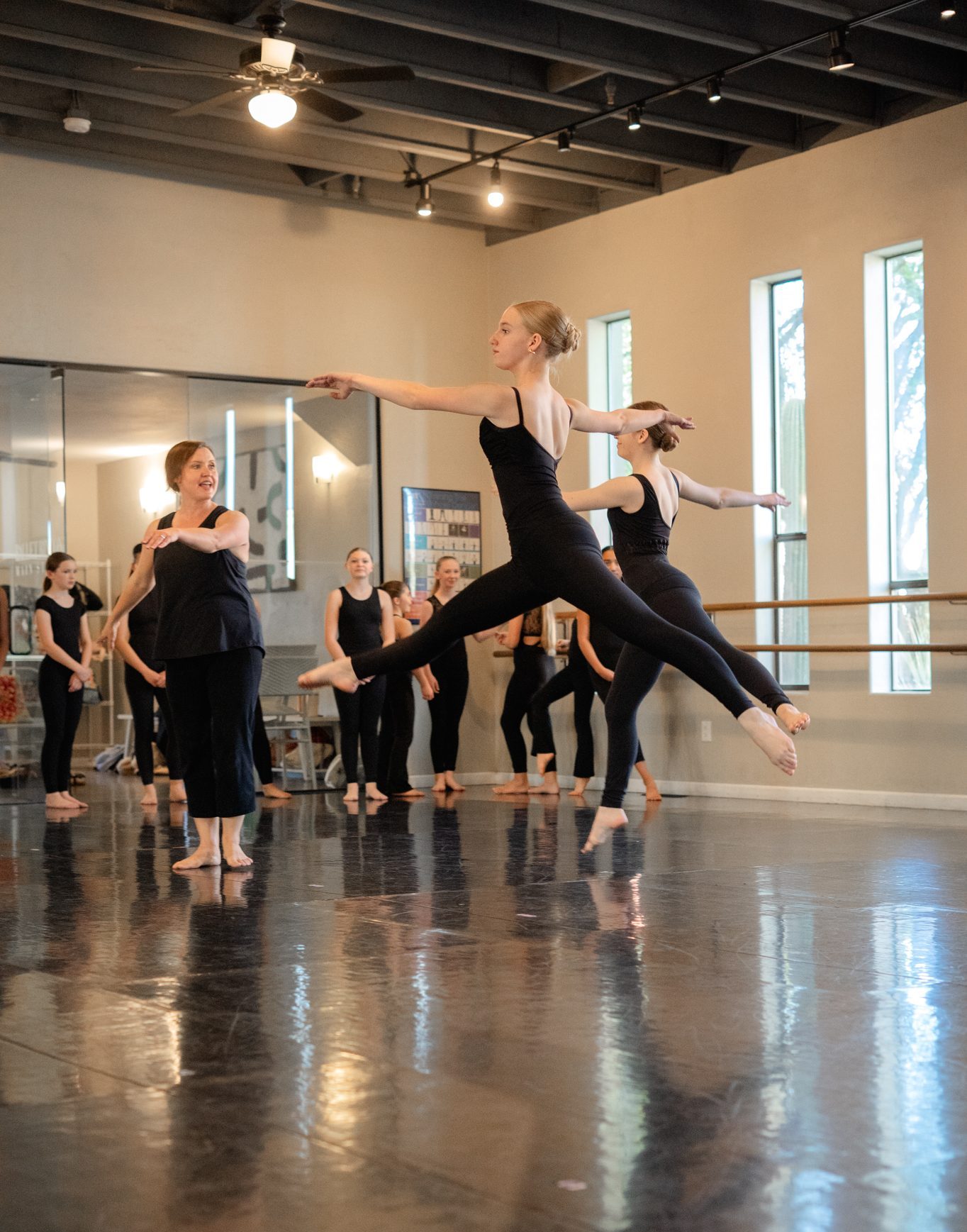
Why should you be teaching empathy in your dance classes?
What’s the most important thing we should be teaching in our dance classes right now?
Pliés? Alignment? Musicality?
If you ask me, it’s EMPATHY.
Hear me out: I know that as dance teachers, we should “stay in our own lane” most of the time. But when it comes to social skills like empathy, I would say, “That IS my lane – all day everyday!” Here’s why:
1.) Only a small percentage of my students will go on to a professional dance career. But they will grow up to be members of our society, who go to work, patronize businesses, maybe have families, and participate in civic life. Spending a fraction of our time together working on social skills, such as empathy, will benefit them in their overall lives them much more than any petite allegro or turn sequence I can drill.
2.) Social skills like empathy are vital for success in the dance field, too. It doesn’t matter how talented you are, if you can’t function on a team, in a company, or as part of a cast with other professionals, you won’t be employed in the industry for very long.
3.) Performing in dance is all about embodying the experience of a character, the emotion of the choreography, or the intention of the choreographer, and presenting it to the audience. If you can’t relate to experiences, emotions, or intentions outside of your own, you will not be a successful performer. Spending time encouraging dancers to develop empathy will help them because more nuanced and engaging performers.
4.) The world is sorely lacking in empathy, and so many of the issues that I often hear dance teachers complaining about – bullying, the occasional bossy dance parent, and even unsympathetic employers – would probably be resolved if we could all just be more empathetic and compassionate to one another. Helping my dance students understand this is one of the best things I can do, for the dance industry and for the world!
5.) Empathetic people are emotionally intelligent, able to identify and relate to the emotions that others are feeling. Because of this, they are often more keenly aware of their own emotions. They are able to recognize and name what they are feeling, and thus can become better able to manage their emotions and have a healthier emotional life overall.
For more about my approach to social and emotional learning in the dance studio, check out this blog post: 5 Vital Social-Emotional Skills Students Learn through Dance – and How to Teach Them!
What is empathy, anyway?
According to the Greater Good Magazine, “Emotion researchers generally define empathy as the ability to sense other people’s emotions, coupled with the ability to imagine what someone else might be thinking or feeling.” Merriam-Webster defines empathy as, the action of, or capacity for, understanding, being aware of, being sensitive to, and vicariously experiencing the feelings, thoughts, and experience of anotherEmpathy can be considered the first step toward compassion: when we relate to what others are experiencing, we are more likely to want to alleviate their suffering or at the very least, treat them the way that we want to be treated. The independent non-profit HelpGuide.org states that “empathy helps you see things from another person’s perspective, sympathize with their emotions, and build stronger relationships—at work, school, and in your personal life.”
How to teach empathy in your dance classes
There are many ways that you can teach empathy in your dance classes, or help your dance students become more empathetic. Some basic principles of empathy include listening, understanding body language, accepting your own vulnerability and allowing others to be vulnerable around you, developing curiosity about the world around you and the people who inhabit it, and exploring new perspectives and ideas. Many of these principles can be explored through movement or other activities in the context of a dance class. Here are 5 ways that you can teach empathy in your dance classes:
“Today I am feeling …” opening ritual
Asking dancers to get in touch with their own emotions can help them better understand the feelings of others. This is a great exercise to use as an opening ritual at the beginning of class, especially on days when the energy of the dancers feels a bit “off” or during times you know might be stressful for dancers – competition weeks, audition season, or school testing days, for example. In this exercise, dancers get a chance to both reflect on and express how they are feeling, and “try on” the feelings of others. Begin by having the dancers stand in a circle. Ask each dancer to think about how they are feeling today, and come up with a movement or gesture that expresses that feeling. I like to offer the dancers the chance to face away from one another, or find a quiet place in the room to stand, while coming up with their movements. This alleviates some of the pressure or fear that might be associated with having others watch them work. When the dancers have come up with their movement, the return to the circle to share. Each dancer takes a turn sharing their movement a few times – without verbalizing the emotion that goes with it. The other dancers then repeat the movement as closely as they can, with the same effort quality and energy. The dancer who is sharing watches the other dancers perform the movement. After the dancers have had a turn to repeat the movement and embody the effort quality and energy, they can guess what the person is feeling. Repeat until all dancers have had a chance to share. For an added bit of team-building, you can combine all of the dance movements into one dance phrase by performing them back-to-back, with transitions added between them as needed.
Shadowing, mirroring, or flocking improvisation exercises
Shadowing, mirroring, and flocking are dance improvisation exercises rooted in the concept of “follow the leader.” When students practice shadowing, mirroring, or flocking, they have the opportunity “try on” the movement and perspective of another dancer. These exercises help dancers get out of their own style of movement, and explore how other people’s movement preferences. They experience how others express themselves in movement, getting a sense of their partner’s emotional life as well as their dance style. Shadowing, mirroring, and flocking are my favorite ways to help students foster empathy, as they are easy to incorporate into dance classes of almost any genre. I also find them highly effective for team bonding, as they help students to connect with one another in a meaningful way. They can also be a bit silly, and quite fun – and I firmly believe that there is nothing like a bit of play and levity to bring people together. I believe that these dance improvisation exercises are some of the most effective ways to teach empathy to our students. As a bonus, they can also help dancers develop observation skills, movement inversion skills, and ensemble dancing skills! Here is how to practice each one:
Shadowing
In shadowing, one dancer stands behind the other. The front dancer moves in a way that is comfortable for them, keeping their body orientation mostly facing forward (away from their partner). Their partner stands behind them, also facing froward, and copies the movements as closely as possible. When the leading dancer moves their right arm, the shadowing dancer also moves their right arm. Be sure that the leading dancer keeps their body oriented toward the front as much as possible – without adding any complicated turns or direction changes – as this will allow the shadowing dancer to keep their eyes on the leader. You can also try shadowing across the floor, with the dancers facing one another and leading and following as they traveling through the space. This is a good introduction to these dance improvisation concepts as it does not involve making eye contact (which can be scary for some students). Additionally, shadowing does not require the following dancer to do any movement inversion, as they copy what they see exactly.
Mirroring
Mirroring is a lot like shadowing, except that they dancers face another another and copies the leader’s movement as if they were their reflection in a mirror. This means that if the leading dancer uses their right arm, the mirroring dancer uses their left. It is still important for the leading dancer to keep their body orientation mostly forward – toward the mirroring dancer – and refrain from complicated turns or direction changes. You can also try mirroring across the floor, with the dancers facing one another and leading and following as they traveling through the space. The benefits of mirroring include eye contact between the dancers, which can be very helpful in the development of empathy, and the added challenge of inverting the movement (performing it on the other side) for the mirroring dancer).
Flocking
Flocking is a variation on shadowing, in which a group of dancers take turns shadowing or otherwise following the leader. I find this exercise to be most effective when the dancers are tightly grouped in a clump. When introducing this dance improvisation exercise, you can assign a leader to start. The rest of the group will shadow the leaders’ movements as closely as possible. As the dancers become more comfortable with this concept, allow the leader to change naturally as the dancers move in the space. For instance, if the leader turns their body to stage right, a dancer on the stage right side of the clump will become the new leader. If the leader moves through space (locomotor movement), the group will follow. As the group navigates the space, new leaders will emerge depending on which way the group is facing. This is a great exercises not only for developing empathy through the trying on of another’s movement, but also for team-building. The dancers must silently shift between leaders and take turns leading and following, all while continuing to move fluidly and as a group.
Simple moment of connection and acknowledgment
If shadowing, mirroring, or flocking feel to complicated for your classes right now – don’t fear! Even simple moments of connection and acknowledgement during class can go a long way to helping your dancers develop empathy. Dance is so often consider an individual pursuit, and we try to get dancers to focus on their own individual growth and improvement. This is not a bad thing, but it can lead to dancers get too into their own personal dance experience in class. When dancers understand that they are part of a class community, and are allowed to relate to other members of that community through movement, they become more aware of others around them and start to develop stronger relationships as a result. Some simple ways that I encourage moments of connection in the dance classes I teach include:
- Starting class in a circle, with eye contact, smiles, and acknowledgment of the other dancers built into our opening stretch.
- Having dancers face a partner for simple warm-up exercises, so that they can see one another and practice dancing with another person.
- Trying simple across the floor patterns with the dancers connected: holding hands, linking elbows, back to back, etc. this helps the dancers develop kinesthetic awareness, and it can be a lot of fun too! Note: Always be sure to get consent from dancers before asking them to touch or be touched by another person. Offer an alternative for dancers who do not want to make physical contact.
- Play interactive dance games, that help dancers break out of their shells, and make connections with one another. The games in The Holistic Dance Teacher Collection are designed with this intent in mind.
- Offering opportunities for the dancers to move freely around the space: walking, prancing, running, galloping, or improvising – and asking them to acknowledge one another either verbally or with body language as they pass.
- Acknowledging the dancers by name as often as I can during class, either as they enter the space, when giving feedback, or when saying thank you at the end of class.
Peer feedback, with an empathetic twist
I am a big fan of using peer feedback in class, and I explain more in this blog post about helping dancers develop better social skills, and this one about giving dancers more effective feedback. To help foster empathy in dance students, I try a slightly different approach:
- One dancer will watch a partner perform a dance exercise, progression, phrase, or combination.
- After watching, the observing dancer will begin their peer feedback session by asking the dancer who performed the movement: “How did that feel?” The performing dancer will talk about how the experience felt physically, mentally, and emotionally.
- The observing dancer will first listen – without speaking. When the performing dancer is finished, the observer can ask more questions, such as, “Do you normally feel X when you perform a movement like Y?” or “How do you think you can make Z feel better/more comfortable/easier/more challenging….?”
- Only after those questions have been asked and answered can the observing students offer feedback on the dancers’ performance of the movement, or suggestions for what they can do to improve.
- Once the conversation is finished, the dancer will perform the same dance exercise, progression, phrase, or combination, with the conversation and feedback from their partner in mind. The observing dancer will watch once again.
- A second feedback section will follow, with the observing student asking, “What changed?” The performing dancer will reflect on how the movement experience changed for them after the first feedback section, and express that to their partner. The observing dancer will then share any changes that they noticed in their partner’s dancing.
- The process repeats with the dancers switching roles.
This emphasis on how the performing student feels as they are dancing can help the observer better understand and relate to the experience of their partner before sharing feedback. It also helps the performing dancer reflect on their own holistic movement experience, instead of just focusing on what their partner has to say about their dancing.
Guess that emotion!
This is another observation activity that has multiple benefits for students. In this activity, one group of dancers will be directed to perform a known exercise – a familiar bit of choreography, progression, or combination – with a specific emotional quality. The other group of dancers will observe the dancers, and try to identify which emotion they are expressing in their performance. The groups will then trade places, with the second group being given a different emotional quality. Repeat multiple times with a variety of emotions!
I love this activity because it helps dancers develop their performance skills, as they figure out what movement qualities, facial expressions, and dynamics best communicate an emotion to the audience. It also develops observation skills, as students watch one other and look for those details in their movement. Finally, by identifying the emotions that are being expressed, the dancers learn empathy.
Open and honest class discussion that prioritize listening
Giving dance students the opportunity to discuss and share how they are feeling is an important way that we as dance teachers can model – and therefore teach – empathy. It is important to make time for open and honest class discussion that prioritize listening and affirming one another’s feelings first, then responding in an empathetic way. These discussions can be related to important events in the students’ dance lives, such as competition scores, audition results, college or career plans. They could be about things you notice in class, such as potential feelings of jealous, exclusion of students from social circles, bullying, or a lack of motivation. They could also be open-ended vent sessions, for students to share about the things that are affecting them in and out of the studio. No matter the topic, it is important that ground rules be set around the importance of listening, not being judgmental, not sharing what is said outside of the discussion, and the value of each individual in the discussion and as a member of the class or team. It should also be made clear that you as the teacher honor and respect the students as individuals and will maintain confidentially to the extent that you are able to, acknowledging that you may need to report unsafe circumstances that are disclosed in the course of the discussion.
BONUS: Dance activities to support your students’ emotional health
In order to develop empathy, students need to have strong emotional health. The dance activities in this blog post can help students understand and express their own emotions in a healthy way. When used in a group setting like a dance class, they can help students become more comfortable with vulnerability, which is vital to the development of empathy.
Do you think empathy is an important skills for dance students to develop? Why or why not? Let me know and share your own ideas for teaching empathy in the comments! Then, visit my Resources page for tools that support a holistic teaching practice. Keep in touch by signing up for my quarterly newsletter, or join me on Facebook at The Holistic Dance Teacher.