
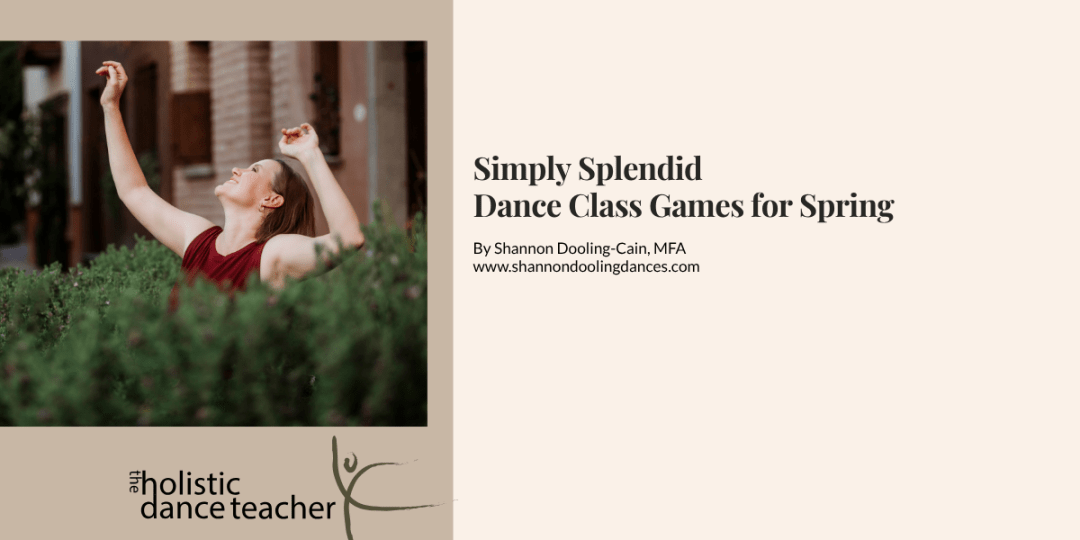
Celebrate the beauty of spring with dance games
Spring is one of my favorite times of year, and I think the best way to celebrate this (or any!) season is by dancing. More sunlight, gentle breezes, and the emergence of colorful flowers and bright green grass all spark joy – especially for kids who have been feeling cooped up all winter long. Nature itself seems to dance, from budding trees blowing in the wind to worms wiggling their way down the rain-soaked sidewalk. And of course, there is nothing better than the annual dance of jumping in puddles after a good spring rain! But for all its beauty, spring can be a difficult time in the dance studio. It is an intense season, filled with rehearsals. competitions, performances, auditions, amid exams. Spring burnout can be a real thing – for students and teachers alike. Dance games can offer a respite from the stress of the season, and help shake us out of the usual routine.
How do dance class games help students learn?
If you follow my blog, you know I love a good seasonal game in my dance classes! Improvisation, games, and creative exercises all provide fun ways to help students develop greater creativity, self-expression, collaboration skills, and performance quality, while also developing a deeper understanding of their dance technique. Tying these games and activities to the season add a celebratory nature to class, and helps students connect what they are doing in dance with what they are experiencing in their lives outside the studio. These 3 Spring-themed dance games can be easily adapted for students of all ages, skills levels, and most dance genres, but are designed with dancers ages 7 and up in mind. After all, students of all ages learn through play!. Moreover, play can be a great way to improve students’ social and emotional health, not only in the wake of the Covid-19 pandemic, but also as the hectic, stressful spring season takes hold.
A note on play as an educational tool in the dance studio
These Spring-themed games for dance class are all based in the philosophy that play can be an important educational tool in the dance studio. Research indicates that students of all ages learn through play, and play can help children can develop important social, cognitive, and emotional skills. Using play as an educational tool can help students gain self-confidence, engage in new experiences, and meet new physical and mental challenges. Incorporating play in the dance studio with students of all ages can have many benefits, from helping students learn new skills and refine their technique to helping them cope with stress and anxiety. Read more about the play in the dance studio in this blog post: Your Ultimate Guide to Play in the Dance Studio.
My favorite Spring-themed games for dance class
Rainbow Suite
The primary objectives of this activity are to help students learn how to apply technique in new ways, create and execute transition steps, and engage in the process of making original movements. Students will work, individually, in pairs, or in teams, or create a dance phrase that corresponds to the word RAINBOW.
To make this an individual activity using the dance vocabulary and technique you are working on in class:
- Direct the student to think of a dance step from their vocabulary that starts with each letter of the work RAINBOW. In ballet, for example, this might look like R-rond de jambe, A-arabesque, etc. In tap, R-riff, A-Alexander, etc.
- Once the student has a step for each letter of the word, they will create transition steps between each to link the steps into a cohesive dance phrase.
To make this a partner/team activity using the dance vocabulary and technique you are working on in class:
- Explain the exercise as outlined in above, but students will work as a team to create they rainbow phrase, not individually.
- Direct the students to choose their collaborative style. Will each student choose one letter and create a corresponding step? Will they work together to come up with each step as a pair or team? How will they decide on transitions? What will they do if disagreements or differences of opinion arise?
To make this a creative movement exploration:
- Follow the above directions for either individuals or partners/teams as desired.
- Instead of asking students to choose a step from their known dance technique, have them create their own dance step and give it a name that corresponds to the appropriate letter. The names could be literal, such as R-Reach with leg, A-Arm swish, or original, such as R-Regiplop, A-Apple Step. It’s always fun to allow the students to be silly and creative!
Moves in Bloom
The primary objective of this activity is to help students develop improvisation skills and creative expression, while counting the music and following directions. This activity is inspired by flowers in bloom.
To play:
- All dancers start on the lower level in a shape that resembles a seed in some way – leave it open to the dancers’ interpretation.
- For 8 counts, the dancers will “bloom” as they move from floor to standing on the highest level.
- After pausing for 8 counts, they will then take 8 counts to “wilt” back down to the low level.
- Allow the dancers to practice this several times, then add layers of complexity such as:
- Take 8 counts to bloom, then 8 to wilt down just to mid level before being infused with sunlight and blooming to the highest level again.
- Take 8 counts to bloom just to the mid level, before drying up from lack of rain and wilting back down to the low level for 8 counts.
- Take 8 counts to bloom, but instead of pausing in stillness on the high level, the dancers are blown from side to side by a gust of wind!
- From your position on the low level, take 8 counts to root down to the earth by moving on the low level only, then bloom to the highest level for 8 counts.
- Grow and wilt just as a stem, without using your arms because your flowers did not bloom.
- Use different count structures, for example: 4 counts to bloom, 4 to pause, and 4 to wilt; 7 counts for each; or 3 to bloom, 12 to pause, 5 to wilt.
More games for dance class
For dance games that help your students learn through play all year long, check out the Dance Games Bundle. This bundle includes educational dance games arranged by season – Back to School, Fall, Winter/Holidays, Spring, and Summer.
Visit my Resources page for tools that support a holistic teaching and creative practice. Keep in touch by signing up for my quarterly newsletter, or join me on Facebook at The Holistic Dance Teacher.
Visit my Resources page for teaching and choreography tools to keep you inspired all year long! Sign up for my quarterly newsletter, or join me on Facebook at The Holistic Dance Teacher.
