
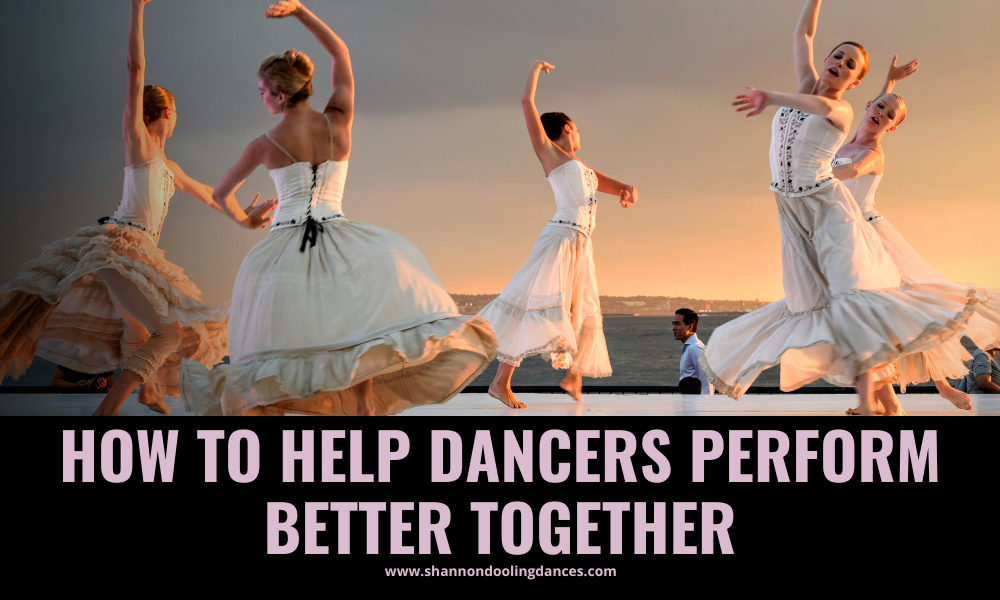
Why teamwork matters in dance
A while back, I had the opportunity to be a guest on Making the Impact Podcast during the season six episode “From Solo to Squad: Respect and Teamwork in Dance.” I had a great time chatting with Courtney Ortiz, Lesley Mealor, and Rachel Roberts about the value and importance of teamwork in dance performance. We spoke a lot about the importance of respect, team culture, and how team-work impacts on stage performance. Throughout the episode, it was mentioned many times over just how apparent it is when team-building building and team bonding is prioritized as part of the rehearsal process.
In this blog post, we’ll discuss the on-stage and off-stage benefits of team-work in dance, the difference between team-building and team-bonding in dance, and simple ways to include team-work in your dance classes.
The on-stage benefits of team-work in dance
When team-work is prioritized, valued, and practiced by a dance team or company, the results are definitely evident in performance. Dances are more polished, performers are more present with one another, emotion and performance quality is more authentic, and the audience can feel the connection among the dancers. It is also very obviously when team-building skills and team bonds are lacking. Group dances look less cohesive. Even if they are technically “clean,” they don’t feel as polished or together as they could be. It becomes a collection of soloists trying to share the stage. The audience can feel that lack of unity, and it’s not always comfortable to watch. The energy is different – and everyone from judges to audience members to the dancers themselves can feel it.
The off-stage benefits of team-work in dance
Prioritizing team-building and team bonding in dance has benefits that go beyond performance, too. First and foremost, it’s simply nicer to be part of a team that gets along! That’s not saying everyone needs to be best friends. But when dancers have the skills they need to work with others, it makes everything from rehearing to sharing backstage space more comfortable. The entire dance experience can be more positive and joyful, as team-building and team bonding activities often lead to a greater level of cooperation and respect.
Moreover, these skills are crucial for dancers as they go out into the dance industry – or whatever other field they may choose. To be successful in school, college, and the workplace, dancers must learn how to work well with others.
The lifelong benefits of team-work in dance
Of course, the goal of dance education is prepare students for life beyond it. Learning how to work as part of a team is important not matter path they take after graduation. For those who want to go on to a professional dance career, learning how to work with others in the creation and performance of choreography. The reality is that few people start their dance career as the principal or prima ballerina, in the leading role, or as a featured dancer. Almost everyone – no matter how talented – starts in the corps, the ensemble, or as part of the team. More than how many turns they can do or how many titles they won, it’s a dancers’ ability to work with others that sets them apart and gets them to the next level. As a dance teacher, choreographer, and adjudicator, I can’t stress enough the importance of developing teamwork skills and learning how to work with the other dancers on your team, cast, class, or company. No one is too good for teamwork! Because truly, you can be the best dancer the world has ever seen, but if you don’t work well with others, very few people are going to want to work with you.
And of course, team-work will be an important skill for those who go into other career fields, too. Dancers learn team-work and other life skills through their dance training. These can be applied throughout a dancer’s life: in school, in relationships, in family life, and in all kinds of career paths. There are countless stories of people who used the skills learned through dance training to find success in the fields of education, medicine, law, government and politics, the military, science and engineering, and so much more. Learning to work well with others is vital in all of them!
Team-building vs. team bonding in dance
It’s now evident that learning how to work well with other is crucial for dancers’ success, on and off stage. There are two ways that dance teachers can help their students develop this ability: team-building and team bonding. While I think that there are difference between team-building and team bonding, the two do go hand in hand. Certainly team-building activities can lead to team bonding, and dancers develop team-building skills through team bonding exercises. Both are necessary for successful and happy dance companies and teams!
What is team-building in dance?
Team-building is about skill-building, both individually and as a group. In team-building dance activities, students work together to meet a shared goal. The goal of team-building in dance is to help dancers develop the skills they need to work well with others in this way. These skills include collaboration, communication, and creative skills as they work together to meet a shared challenge. As dancers participate in team-building activities, they learn to:
- collaborate and work with one another to meet a shared goal
- communicate in effective ways so that the group can succeed at their assigned tasks
- understand their own work style and preferences
- understand and accept the work style and preferences of the other participants
- appreciate what they can do as a group, when they work together
In team-building, a sense of community comes as the result of this shared work, as students realize that each member of the team is integral to the group’s success. However, the focus remains on the work and the skills that are developed through it. There is great value in the team-building, both for the individuals and the group. Collaboration, communication, and creativity are important life skills that will help the group dance better together and work more cooperatively in classes and rehearsals. More importantly, these are skills that will also serve the individual dancers well in their lives outside the studio.
Team-building is great to practice in any dance setting, from a “one and done” master class or workshop to a season-long session to a dance team or company. You can learn more about team-building in dance and find great dance activities for team-building in this blog post: My Favorite Team-Building Games for Dance Class
What is team bonding in dance?
Team bonding goes beyond skill-building, with a focus on fostering deeper relationships among the dancers. Team bonding is not just about working together or meeting a shared goal. In team-bonding activities, students learn make connections, find common ground, and be vulnerable with one another. The goal is to build trust among the dancers, as learn to both trust one another and see themselves as worthy of their peer’s trust. In team-bonding, a sense of community comes from sharing meaningful experiences, intentionally creating team connections, getting to know one another more deeply. Students will often develop collaboration, communication, and creative skills through team bonding, but that is secondary to the relationships being built. The students ultimately realize that each member of the team – including themselves – is valued and appreciated for who they are, not just because of what they can bring to the team. To learn more about team bonding and find great dance team bonding activities to use with your classes, companies, or teams, check out this blog post: Dance Team Bonding Strategies and Activities
Simple ways to incorporate team-work into your dance classes
At the very tail end of my discussion of the Marking the Impact Podcast, we brought up the idea that team-building and team bonding in dance doesn’t have to be complicated. It doesn’t take much to help dancers learn how to work together and perform better as a group on stage. This is an area I thought I could expand on in this blog post, as it’s something I could talk about for a long time!
Team-building and team bonding activities like those mentioned above can go a long way in helping dancers learn to work together and perform as a group on stage. However, team-work can be also fostered in other ways. In fact, it can be as simple as spending time in class or rehearsal helping the dancers learn to be present with one another in the moment.
Here are some of my favorite, super simple strategies to use in your next class or rehearsal:
Start and end class in a circle formation
Starting and ending class in a circle formation, with the dancers looking at one another, helps the dancers develop a sense of community. Practice deep breathing together and sensing the others around one another. When dancers learn to breathe together, it can improve their on-stage timing and energy.
Dance facing a partner
Have the dancers face one another as they do simple, stationary warm-up or technique exercises. This helps them to be become more comfortable making eye contact – which can be tricky in our digital and screen-filled era! Watching others and making eye contact is critical for dancing in unison on stage.
Use physical touch and connection
Try simple across the floor patterns with the dancers connected, such as holding hands, linking elbows, back to back, or even holding hands. This helps the dancers develop kinesthetic awareness, and it can be a lot of fun too! Always be sure to get consent from dancers before asking them to touch one another.
Use play and dance games
A fun way to help the dancers learn to be present with one another is to play interactive dance games. Play and dance games can help dancers break out of their shells and make genuine connections with one another. All of the games in The Holistic Dance Teacher Collection are designed with this intent in mind.
Try peer feedback and class discussions
Activities that get dancers interacting with one another in productive ways is a great way to help them be present with one another and learn to work together. Consider using peer feedback or class discussions to get dancers observing, supporting, and engaging with one another in new ways. You might like the suggestions in this blog post: How to Teach Social Skills in Dance Class.
Consider creative rest
Mindfulness can help dancers learn to be present in the moment, which will help them dance better together on stage. Activities like guided meditation, body, scans, and creative rest to help get dancers grounded in the present moment and more aware of themselves and one another. Check out The Holistic Collection of Dance Activities for Creative Rest for 15 easy to use creative activities that can be used as a warm-up or cool-down in class or rehearsal.
Share your own strategies!
How do you help your students learn to be present with one another in the moment? I’d love to learn from you. Please share your ideas and other strategies for team-building and team-bonding in the comments!
Visit my Resources page for tools that support a holistic approach to dancing, teaching and creativity. Keep in touch by signing up for my newsletter, or join me on Facebook at The Holistic Dance Teacher or The Holistic Dance Parent.
